Showing posts with label abstract. Show all posts

Thursday, 28 April 2022

Wreckpiece


Click on the image to enlarge.
Copyright © text & image 2022 by George Taylor.  All rights reserved.


Wreckpiece

Metal, dowel rods, cardboard and acrylic on canvas in deep, white painted timber frame

64cms x 64cms

2022

The coast of the British Isles is littered with shipwrecks of almost every type, and the coast of Cornwall because of its location and topography, inevitably has its fair share.

Although born in Devonport, the untutored painter Alfred Wallis is often considered as ‘Cornish,’ as for most of his life he lived in St Ives, the fact that he lived in St Ives was fortuitous, as it was there in 1928 that the painters Ben Nicholson and Cristopher Wood ‘discovered’ him – had he been living elsewhere, it is quite possible that he might have remained unknown.

His various paintings on the theme of the Wreck of the Alba, graphically depict that eponymous steam propelled vessel as it was quite literally being overwhelmed by massive waves at Porthmeor Beach on 31st January 1938. Despite the valiant efforts of the St Ives lifeboat, which itself capsized and was washed on to the rocks, five members of Alba’s crew were lost. Most of the remains of the vessel have been washed away, but the boiler is still discernible at exceptionally low tides.

Vastly different, from Wallis’ powerful and expressive painterly recollections of an event, the aftermath of which, he almost certainly witnessed, are the incisive, mostly black and white photographs of wrecks of mainly, but not exclusively, sailing craft around the coast of Devon and Cornwall taken since 1869 by successive generations of the Gibson family of the Scilly Isles.

Wreckpiece, is different again, and although essentially an abstraction, allows for an imaginative response in the viewer, the various elements of its composition perhaps ‘standing in’ for objects, rather than imitating them in meticulous detail. The piece of found, weathered metal, for example, is visually interesting and plays a key part in the composition, but at the same time may serve to represent a piece of marine wreckage – possibly a remnant of a boiler, or a prow and the broken cylinder, possibly a funnel.

The intersecting rods are essentially an abstract, sculptural construct, serving to hold the image firmly in place, but may also serve as co-ordinates, indicating the location of a shipwreck.


George Taylor

April 2022

Wednesday, 4 November 2020

Encounter


Click on the image to enlarge.
Copyright © text 2020 & image 2010 by George Taylor.  All rights reserved.


Encounter
2010, 80cms x 80cms, acrylic paint, textile, paper and pencil on canvas. 

Visual art that does not pretend to be a constructed representation of something else in the real world but is itself a discrete entity in the real world, should like music, have an autonomous, ‘life of its own.’ It should have an energy, a vitality, should excite the senses and the emotions, hopefully, beyond self-conscious thought and words. 

Unless there is an immediate and lasting connection with the senses and vitally, directly with the observers’ nervous system, it is likely to serve no purpose beyond the decorative. 

The late American abstract expressionist painter Franz Kline, when asked to explain his abstraction said: 'I’ll answer you in the same way Louis Armstrong does when they ask him what it means when he blows his trumpet. Louis says, Brother, if you don’t get it, there is no way I can tell you.’ 

There is a tendency to over intellectualise painting and art in general and of course, this the territory of the critics and the curators, but frankly, with the entity in front of you, you either respond or you do not. There may of course be degrees of response, and provided you do not automatically reject within a few seconds, as many do, more complete and satisfying responses may occur given prolonged engagement. 

However, as Louis firmly implied, there is no way that he, or anyone else can explain, or teach you how you should respond, or what you should feel, but the receptive viewer will know instinctively if that vital connection has been made. 


From a suite of four paintings: Encounter, Odyssey, Enigma and Quest, on Gallery 7 of my website. 


George Taylor 
October 2020 


Sunday, 16 August 2020

White Rock


Click on the image to enlarge.
Copyright © text & image by George Taylor.  All rights reserved.


"A painting is a physical entity and, if successful, to the responsive viewer, hopefully, will engender a 'physical' experience via the eyes and the human nervous system, just as an actual encounter with powerful natural forces will directly affect the senses and the nervous system. It follows that the more extreme the exposure the greater the impact this will have, not merely at the time of the experience, but in a lasting manner via memory and recollection.

Terry Frost made a painting called Force Eight which was an immediate and direct response to a walk to his studio in St Ives in a force eight gale, the result is a unique abstracted rendering of that particular 'forceful' experience in paint. 

Patently, it is not a detailed figurative rendering of the experience, but was for him the essence of that totally engaging event expressed in colour, form and critically the feeling of dynamic energy conveyed through the marks left by the expressionistic brushstrokes, and the masterful use of pictorial space.

My painting here is not quite as 'abstracted' as Terry's but is the consequence of a similar 'all-embracing', and totally engaging experience in the face of powerful natural forces in a particular and imposing location."

George Taylor


Taylor-Thwaites Studios,
Stonewalls, Sturt Road, Charlbury, Chipping Norton, Oxfordshire, OX7 3EP.
01608 810174
wwwgeorgetaylorart.com

'White Rock' appeared on the UK Artists online 'Artsy' Gallery page
Artwork White Rock on UK Artists


Monday, 29 June 2020

Wheal Country


Click on the image to enlarge.
Copyright © text 2020 & image 2010 by George Taylor.  All rights reserved.
Click on the image to enlarge.
Copyright © text & image by George Taylor.  All rights reserved.


Place and Time: Botallack Mines

I have visited the site of the former mine complex at Botallack a number of times, over many years, and consequently have retained a clear image of that location in my memory, which I can access from my mental ‘filing system’ at any time, almost like a ‘picture postcard’ that I carry around in my head.

Except that my ‘picture postcard’ image is very different to the stereotypical, ready-made ‘composition’ of the dramatically situated, but now long derelict former Crowns engine houses, dropping sequentially and precariously down to the sea, with the tide pounding at the rocks into which their foundations are set.


W.S. Grahams’ poignant poem, The Thermal Stair, about his friend, the Cornish born painter, Peter Lanyon, evokes the unique atmosphere of this and of other nearby places on this ‘Tin Coast’, with their bleak and seemingly, randomly placed archaeological remnants, which speak to me as much about the hardnosed and dangerous industry and fairly recent human history, as they do of an untainted, natural, and sublime coastal landscape.


Peter, I called and you were away, speaking
Only through what you made and at your best.

Look, there above Botallack, the buzzard riding………..


There are numerous, fragmented hints throughout this liminal coastal landscape, (as well as those lost in the mine-workings deep beneath the ocean) scattered bits and pieces, made as much from concrete and wrought iron, as from stone, which now abstracted from their original context, are gradually in the process of being reclaimed by nature and defaced by man, offering only vague clues as to their actual purpose within the whole.


So a pictorial illusion, a realistic representation combining constructed perspective with ‘meticulous craft and miraculous detail’, to paraphrase Robert Motherwell; like a mere ‘picture postcard’, would not for me, do justice to the feelings and responses, these once unblemished natural coastal locations, now scarred and littered with strange and abandoned post-industrial detritus and relics, generate. 


Therefore, a metaphorical and symbolic synthesis of what I have felt, and seen as a result of directly experiencing this dramatic location over a long period of time, a kind of abstracted reinvention, rather than a mere illustrative copy, is for me a truer means of expressing my particular sense of this place.

I do not rely on photographs to make an image, that would be disingenuous and counterintuitive, but I have included a few of the snaps I took at Botallack around ten years ago, simply as references for some of the visual elements used in Wheal Country.

George Taylor


Friday, 1 May 2020

Ancient Land


Click on the image to enlarge.
Copyright © text 2020 & image 2012 by George Taylor.  All rights reserved.


It is not always helpful to attempt to explain a painting such as this in words. It is, after all, a constructed image, and is necessarily ‘of itself’, a material, but not a literal entity and words can sometimes mislead and become counterproductive. 

If we insist on interpreting  visual art ‘literally’, we can easily miss the point, art has no obligation to represent figuratively, neither is there an essential need for it to be justified in words, any more than does music or dance.

Songs and poems are usually comprised of words, but should not need additional ‘words’ to prop them up. 
 
It is not understanding that really matters, but feeling and connection.
It is a risky business putting a picture ‘out there’, as it has to stand up entirely for itself, and is thus totally vulnerable – the best one can hope for, is that in some, there might be that connection.  
However, when I made this work in 2012, I gave it the title Ancient Land, partly because at that time I had been thinking a lot about Eliot’s, East Coker, from his Four Quartets, and certain passages from that poem may have been at the forefront of my mind.

                                              In that open field
If you do not come too close, if you do not come too close,
On a summer midnight, you can hear the music
Of the weak pipe and the little drum
And see them dancing around the bonfire………

What does the term ancient mean?
We tend to use the word relatively, in terms of modern human history, but in that sense, ‘ancientness’ is just a few millennia, but in terms of the age of the Universe, the Solar System, and the Planet, not really very much at all.

George Taylor
April 2020


Taylor-Thwaites Studios, Stonewalls, Sturt Road, Charlbury, Chipping Norton, Oxfordshire, OX7 3EP
01608 810174
www.georgetaylorart.com   www.janicethwaites.org.uk


Friday, 13 March 2020

Homage to Barcelona


Click on the image to enlarge.
Copyright © text 2020 & image by George Taylor.  All rights reserved.


Barcelona, the place, is about energy, vitality, and colour and thus, inevitably about art.

The art of Joan Miro, Picasso, Gaudi and, for me especially, Antoni Tapies, all of whom are celebrated by museums in the city.

The unique verve and dynamic of the Catalonian capital is compelling, and in my view, can only be effectively be expressed visually and emotionally in abstracted form. The only real concession to a landscape format in the picture is a broad hint of a horizon line as if looking down spatially on to the city from the lofty heights of Montjuic Hill, where the architecturally inspiring Fundacio Joan Miro is located.

Thus, this image is the synthesis of an experience, rather than a single viewpoint ‘representation’, an aggregate of organised fragments of a vital, living place - movement, colour, form and space, and all those other qualities which make the city greater than the sum of its parts.

How else could one pay homage to the essence of this unique place in two-dimensional terms, mere figuration could not do justice to its spirit, its history or its art.

However, it is vital that a painting transcends its ‘subject’ and becomes something else, something autonomous, that is able to stand on its own, otherwise what would be the point of making it. In that sense, the title ‘Homage to Barcelona’ is essentially, a term of reference.

George Taylor
February 2020

……………………………………………………………………...

Should you wish to view this work in our studio gallery, please call us on 01608 810174. It is attractively framed in limewashed hardwood and set in a wide, deep cut, white mount.

‘Homage to Barcelona’ has been shown at the Royal Birmingham Society of Artists Gallery, in Birmingham, of which George is a Full Member, and was also included in the selection for the Ironstone Art Prize at Banbury Museum in 2018. It also appeared on the UK Artists online ‘Artsy’ Gallery page.

Taylor-Thwaites Studios, Stonewalls, Sturt Road, Charlbury, Chipping Norton, Oxfordshire, OX7 3EP.

Tuesday, 12 November 2019

When Only the Moon Rages


Click on the image to enlarge.
Copyright © text 2019 & image 2009 by George Taylor.  All rights reserved.


The title of this mixed media painting is borrowed from a poem called ‘In my Craft or Sullen Art’ by Dylan Thomas.
I made the work in 2009, I was familiar with the poem, but chose the title after completing it, as for me, when making a painting, it is vital that I am as free as is possible from the direct influence of a  conscious subject.   

The  intention is to convey a sense of drama, in the contrast between the hot colours in the lower third of the picture, and the cooler, deep blues in the upper two thirds, the intersected and conjoined diversity of marks across the picture plane, contribute to a feeling of circular motion and restless energy.

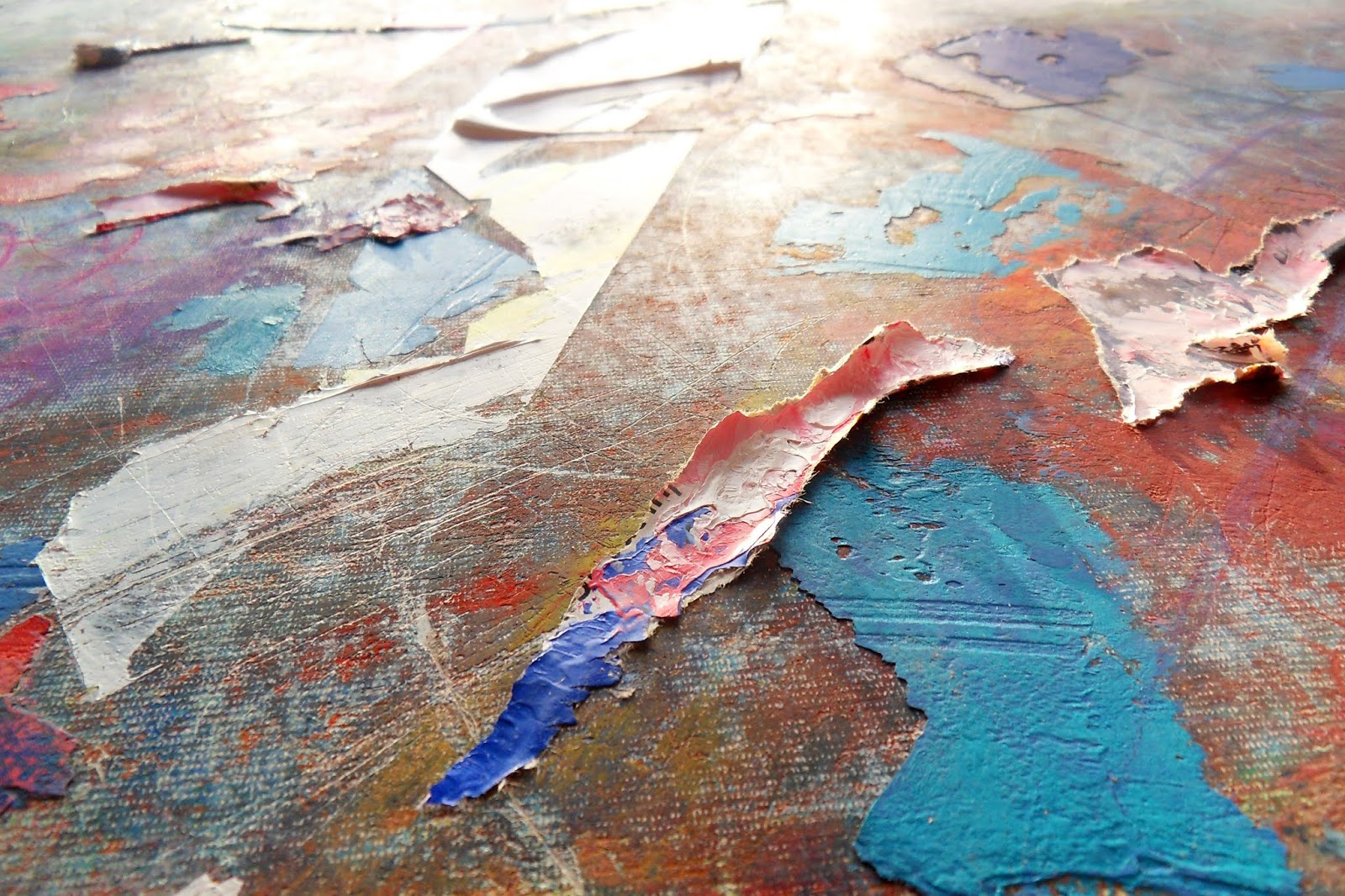
The picture is also about materials per se, not merely as a vehicle for creating an illusion, but materials ‘of themselves’. The lower half is comprised of thick impasto, applied by whatever blades and tools seemed most appropriate at the time,  sometimes the paint is scraped off, to show previous layers.

The colour to the upper half is vigorously applied by brush and palette knife. In parts, some masking has been used, and in others the surface is gouged through to the paper;  the angular, but nebulous marks are made with pastel and chalk.

The aim of this truly, mixed media approach, is to create as much surface interest as possible, whilst at the same time, striving to make an immediate and visually arresting image.

George Taylor
October 2019

Taylor-Thwaites Studios, Stonewalls, Sturt Road, Charlbury, Chipping Norton, Oxfordshire, OX7 3EP
………………………………………………………………………

This picture is on Saunders Waterford (300lb) Cotton Mould Made Acid Free Paper, set within a deep cut, off-white mount within a lime-washed hardwood frame.  It measures 81 centimetres x 100 centimetres overall and will be included in Mallam’s, Modern and Post War British Art Sale in Oxford on Friday 6th December 2019. (max.fisher@mallams.co.uk  01865241358  


Friday, 4 October 2019

Ariel's Song


With the help of a professional photographer, I am planning to make a video of a ‘journey’ through a selection of my ‘Elemental Series’. Rather like a helicopter, or a drone moving through a three-dimensional, sculptural space.

Most of my wall-hung work is made on a flat surface, rather than on an easel, only placing it upright occasionally to assess its veracity. I have long been fascinated by the effect of laying the work flat, and then experiencing this as a kind of ‘terrain’, as if it were, almost literally, a landscape.


This piece is not from that series, is multi-coloured, and less dimensional in actual terms, but these still shots give some idea of how visually exciting that concept might be.

Click on the images to enlarge.
Copyright © text & images by George Taylor.  All rights reserved.


Sunday, 12 November 2017

Life in the abstract: George Taylor’s fifty years as an artist


Click on the images to enlarge.
Copyright © text 2017 & images by George Taylor.  All rights reserved.


In his work, Taylor attempts to organise aggregated glimpses and fragments of form, the juxtaposition of vaguely referential, symbolic, abstracted and ambiguous marks being pivotal.

The product of this approach becomes a self-contained entity having a concrete existence in the natural world but not defined by it or dependent upon an illusory construct of it, but possibly having oblique or allusive references to it.

He strives to construct a compositionally coherent, essentially self-referential image that resists absolute definition or rigidly literal interpretation, free from the prop of the visually perceived world 'out there' or of the 'deceit' of the figurative.

Nearing, 1963

George Taylor sees an inherent integrity in abstract art… through his visual world of ‘imagined spaces and specific places’ he explores how to communicate the complex.

He believes works of art essentially become objects, left to be encountered by others, and the power of abstraction is held in intensely felt forces, captured through art at a particular time and place.

ART BLOG asked Taylor what drives him to create, and what makes abstraction so compelling…
What drew you to abstraction?
My early training in art in the late 50s and early 60s involved drawing from life: pictorial composition, anatomy, colour analysis and the study of perspective…
It was a thorough traditional and academic grounding in the essential skills of perception and observation, none of which I regret.
However, I discovered very quickly that mere representation, even when undertaken skilfully and imaginatively, did not satisfy me.
I was inexorably attracted to what is popularly referred to as abstraction, or possibly more accurately, non-figuration.
Equinox, 1961

I made my first fully abstract painting in 1961 and in 1963 began making white, wall hung abstract constructions with Michael Baldwin, later of the influential conceptual art collaboration Art and Language.
A little later in that year, I met and got to know the internationally-known painter Sir Terry Frost RA, and began to develop further my strong interest in colour, form and, critically, with abstraction, pictorial space.
What, for you, is the chief satisfaction to be had in making abstract art?
The virtually boundless freedom and creative possibilities it affords, in that one is not restricted to the depiction of a subject, or at least, to something ‘represented’.
Freedom, though, implies responsibility as a corollary, and amongst other things, the making of abstract art requires rigour, insight and dedication.
Silent Motto

North Atlantic Odyssey

Of all the arts, abstract painting is the most difficult. It demands that you know how to draw well, that you have heightened sensitivity for composition and for colour, and that you be a true poet. This last is essential.
Wassily Kandinsky 1866 – 1944.

You have spoken of ‘the deceit of the figurative’… could you elaborate?
I don’t seek to criticise representational art, or to be controversial, and comparisons should not be an exercise in semantics.
Any attempt to reproduce an imitation of the objective world in paint, or any other medium, is arguably of the nature of a ‘deceit’ (the quotation marks are important) and the more skilfully this is done, then logically the more ‘deceitful’ it becomes.
George Taylor in his studio, Shipston

Therefore, what are regarded as the best or most successful figurative paintings are also the most ‘deceitful’.
This though, does not detract from the fact that they remain the best figurative paintings, and amongst the very best works of art ever made.
It is crucial to regard the word ‘deceit’ in relation to its opposite ‘honest’, or perhaps, ‘deceitfulness’, as opposed to ‘honesty’.
Thus, a representation of the objective world on a two-dimensional plane is by definition, a ‘deceit’, as the resulting image is not ‘of itself’, but purports to be a representation of something outside of itself; whereas a non-figurative or abstract work is essentially self-referential, and therefore innately more ‘honest’.
Spacetime

Obviously, there are degrees of representation and thus of abstraction, but it is only when all objective references are excluded, and a work relies entirely on the materials of its making, does the result become wholly abstract and non-referential, and is therefore, more intrinsically ‘honest’ by definition.

Abstraction is real, probably more real than nature.
Josef Albers 1888 – 1976

George Taylor, September 2017
Reference: RBSA Birmingham Art Gallery ART BLOG